Friday, October 7, 2016

Planning To Go To Europe During The Holiday? Here's Top Five Of Europe's Best Christmas Markets

MANCHESTER, ENGLAND - DECEMBER 16: Shoppers enjoy Manchester's Christmas Market with food stalls, bar's, Christmas decorations and various gift stalls outside Manchester Town Hall on December 16, 2015 in Manchester, England. (Photo by Richard Stonehouse/Getty Images)(Photo: Photo by Richard Stonehouse/Getty Images)

The holiday season is approaching, and what better way to celebrate it by going to the Christmas markets? These spots are particularly popular in Europe, and they usually happen from November to December. If you are in the continent during the festive season, you better not miss the chance to experience it yourself.

Visitors, both local and international, flock these markets for sweet treats, recreational activities like ice-skating, and for the overall Christmasy ambiance.

Here are the Top five Christmas markets in Europe:

1. If you are a fan of history, then the Manchester Evening News recommends you to visit Munich Christmas market. Just imagine having to experience all things Christmas against the alps, and in every corner of the small town.

2. The Old Town Square in Prague, Czech Republic transforms into a Christmas wonderland during this period. Guests can indulge in the best Czech beers and fresh pastries being prepared right in front of them. This is where you'll experience an authentically Czech Christmas.

3. According to European Best Destinations, the best Christmas market is in Advent, Zagreb. It's more of a bright street party than an actual market, and it's more about nostalgia than anything. It features musical shows featuring diverse talents, and art exhibitions.

4. Winter Wonders Christmas market in Brussels is one of the key events in the country. They usually have parades and a huge Christmas tree in the middle of the venue. They go literally big on the décor and on the fun, and this is a must for visitors during the season.

5. If you're all about the food during the holiday season, then you'll definitely enjoy the Christmas market at Vienna. The scent of freshly baked goods take over City Hall Square, and they have free-flowing warm drinks to heat things up during the cold weather. It's truly Viennese and truly one to remember.

If you're flying to the continent during the Christmas holidays, don't forget to visit the local Christmas market for good eats and fun finds.

Here's a guide to making the most out of European Christmas markets:


Source: Planning To Go To Europe During The Holiday? Here's Top Five Of Europe's Best Christmas Markets

Thursday, October 6, 2016

GSTC 2016 European Regional Meeting in Athens: E-Blast, web and blog content

Join experts and tourism practitioners from throughout Europe in Athens on Nov 23-24 to debate best strategies in today's environment to utilize sustainable tourism management mechanisms for destinations and businesses. Speakers include: TUI Benelux Manager of Sustainability Melvin Mak, BookDifferent.com CEO Lonneke de Kort, GSTC Chair Luigi Cabrini, German National Tourist Board Sustainability & Innovations Manager Olaf Schlieper, Green Destinations Founder & Director Albert Salman, Hellenic Hotels Association Head of Sustainability Alexandros Angelopoulos, UNWTO Secretary General's Special Adviser George Drakopoulos, Ecotourism Ireland CEO Mary Mulvey, Travelife for Hotels Commercial Director Sören Stöber, Travelife for Tour Operators Manager Naut Kusters, and many more.  

Event title: GTSC European Regional Meeting

Date: November 23-24, 2016

Time: 8:30 (8:30am) to 18:00 (6:00pm)

Location: Zappeion Conference and Exhibition Center, Athens, Greece 

Register here before October 7 to save €50: https://www.eventora.com/en/Events/gstc-european-regional-meeting


Source: GSTC 2016 European Regional Meeting in Athens: E-Blast, web and blog content

Wednesday, October 5, 2016

Along Germany's Coast, A Nazi Resort Becomes An Upscale Destination

Enlarge this image

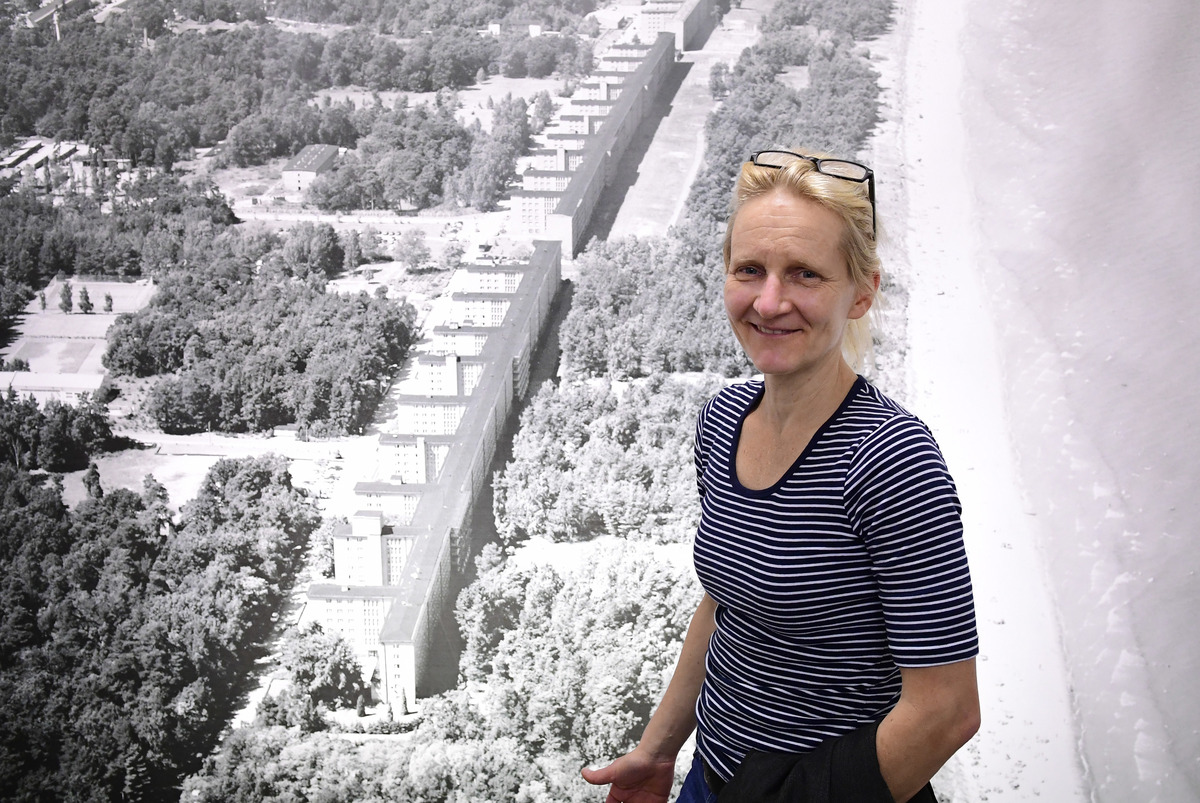
Katja Lucke, chief historian of the Prora resort complex on the German island of Ruegen, worries that redevelopment of the site as an upscale holiday destination glosses over a dangerous part of German history that shouldn't be forgotten. The Nazis built the complex in the 1930s, but abandoned it during World War II. Tobias Schwarz/AFP/Getty Images hide caption

toggle caption Tobias Schwarz/AFP/Getty Images

Katja Lucke, chief historian of the Prora resort complex on the German island of Ruegen, worries that redevelopment of the site as an upscale holiday destination glosses over a dangerous part of German history that shouldn't be forgotten. The Nazis built the complex in the 1930s, but abandoned it during World War II.

Tobias Schwarz/AFP/Getty Images

Architecture was one of Adolf Hitler's passions, and he commissioned hundreds of buildings and arenas reminiscent of imperial Rome to inspire and intimidate.

It's a legacy Germany has struggled to erase by re-purposing or razing Nazi-era structures. The Federal Office for Migration and Refugees, for example, was placed in an old SS barracks in Nuremburg, while the German Finance Ministry took over the Nazi aviation building in Berlin.

The Berlin bunker where Hitler spent his final days was reduced to a parking lot.

Usually there's little or no complaint about these refurbishments. But one government-sanctioned plan for a Third Reich landmark is sparking a public outcry — a commercial exploitation of the biggest Nazi relic on the Baltic Sea coast.

It's a resort Hitler built between 1936 and 1939 along sandy, white beaches for working-class Germans, one that was grandiose even by Nazi standards. Concrete dormitories that are six stories high and 550 yards wide were erected side by side over 2.8 miles of pristine coastline on the northern island of Ruegen.

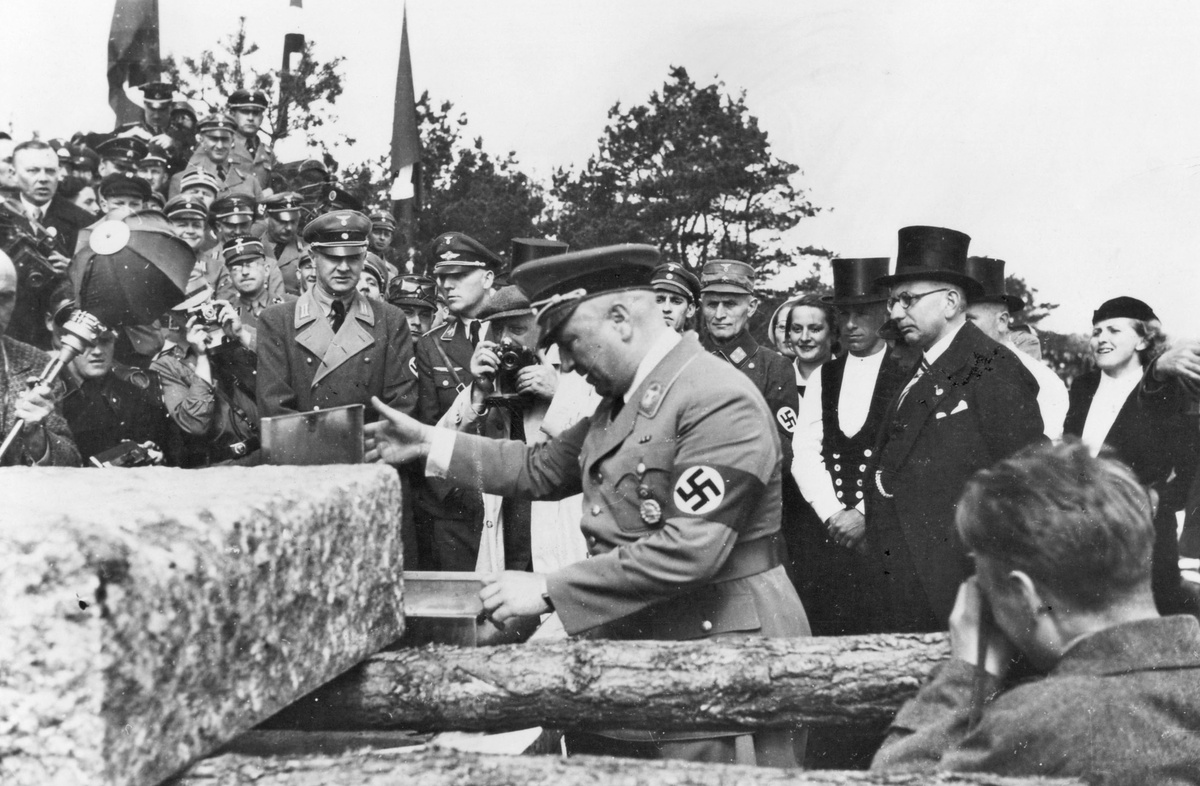
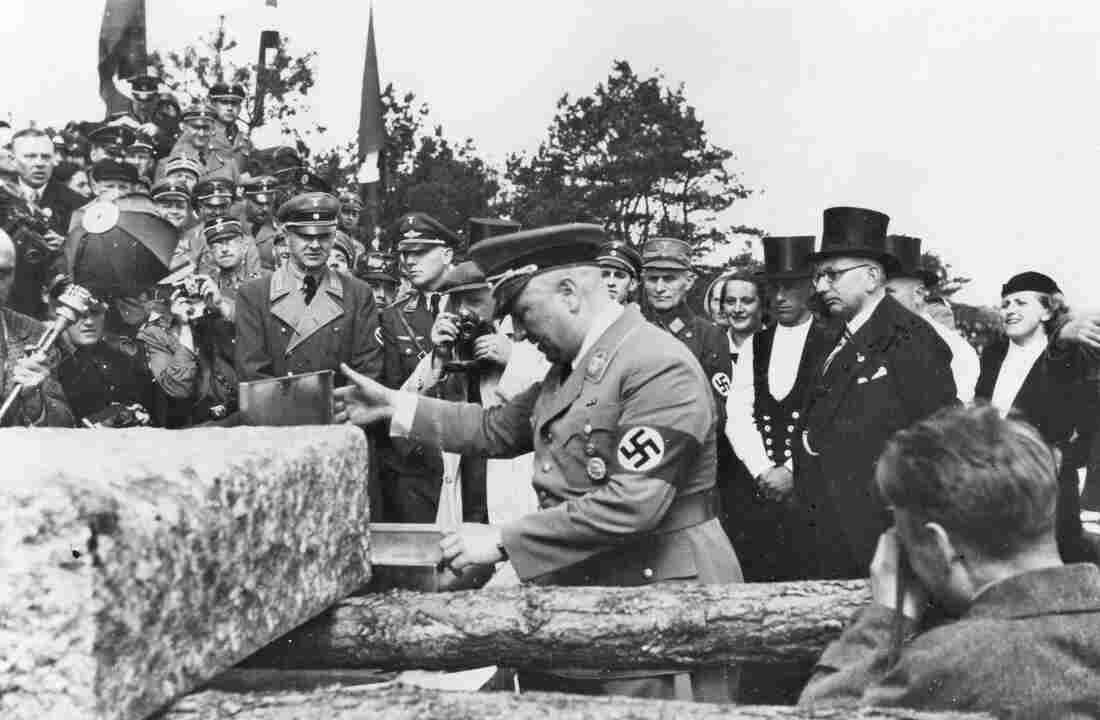
The cornerstone of the Prora resort was laid 80 years ago by then-Labor Front Chairman Robert Ley, who called it "a monument to the German people" and predicted it would still be standing 1,000 years later. The resort was owned and run by the Nazis' Kraft Durch Freude or "Strength Through Joy" leisure movement, a state-run organization designed to promote the advantages of National Socialism to the German working class.
Enlarge this image

Robert Ley (center), head of the German Labor Front, visits Ruegen in 1936. ullstein bild via Getty Images hide caption

toggle caption ullstein bild via Getty Images

Robert Ley (center), head of the German Labor Front, visits Ruegen in 1936.

ullstein bild via Getty Images

But the sprawling retreat that was meant to house and indoctrinate up to 20,000 people in National Socialism — each for less than $9 a day — never actually opened because of the impending war, says Katja Lucke, co-director of the Documentation Center, a museum at the site that details the resort's Nazi history.

She recounts how the Soviets later blew up one of the buildings and the East Germans turned what was left into a secret military compound that wasn't listed on public maps.

Following the collapse of Communism and German reunification, the resort became a ruin, overgrown with trees and mired in debate.

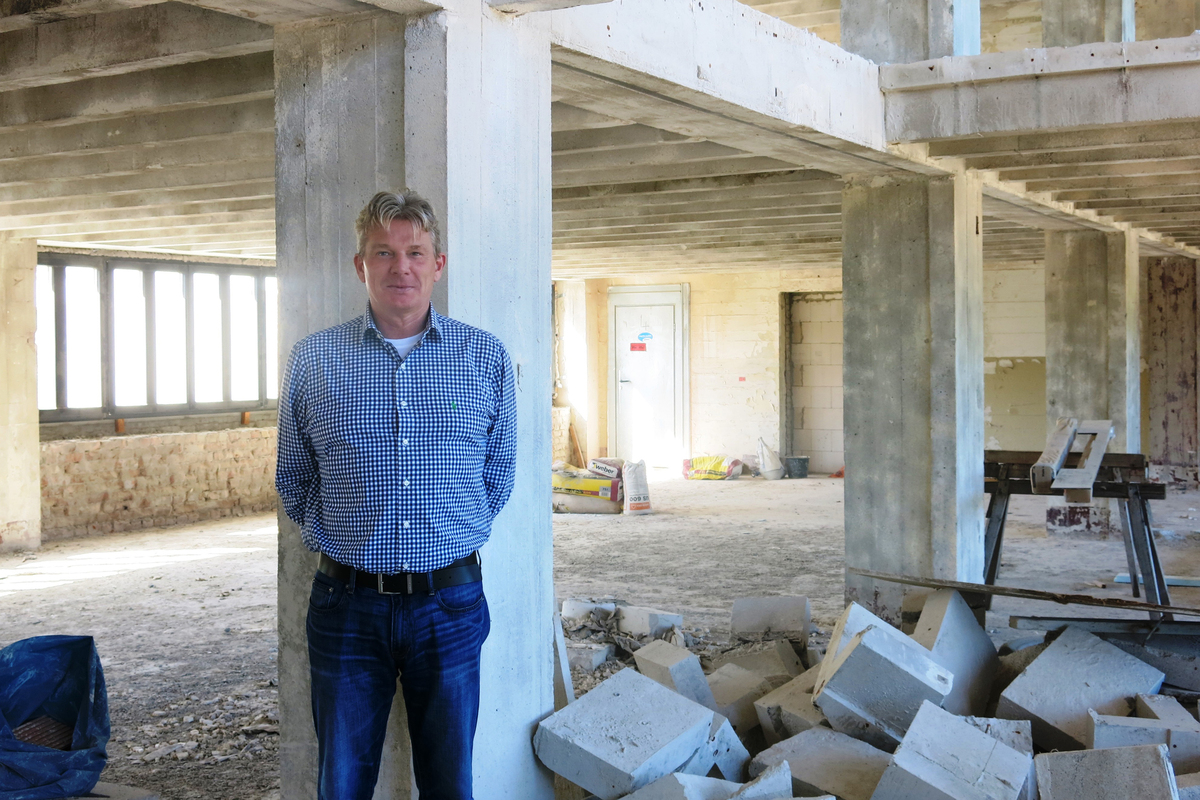
"Everyone was thinking, 'What is going on with this complex?'" real estate developer Ulrich Busch recalls. "It was a huge, ugly, fallen-down angel on the seaside. And a lot of people were saying: 'Hey, we have to tear it down.' But a lot of people were also saying: 'It's a historical site and we have to protect it.'"

Busch and several other developers decided the answer was a little bit of both. They persuaded federal and local officials to waive historic preservation rules and allow them to build upscale condominiums and a luxury hotel and spa within the existing foundations. But one concession they insisted on was allowing controversial changes like adding balconies and rooftop terraces to the exteriors, even though changes are not normally permitted to the original design of historic landmarks.
Enlarge this image

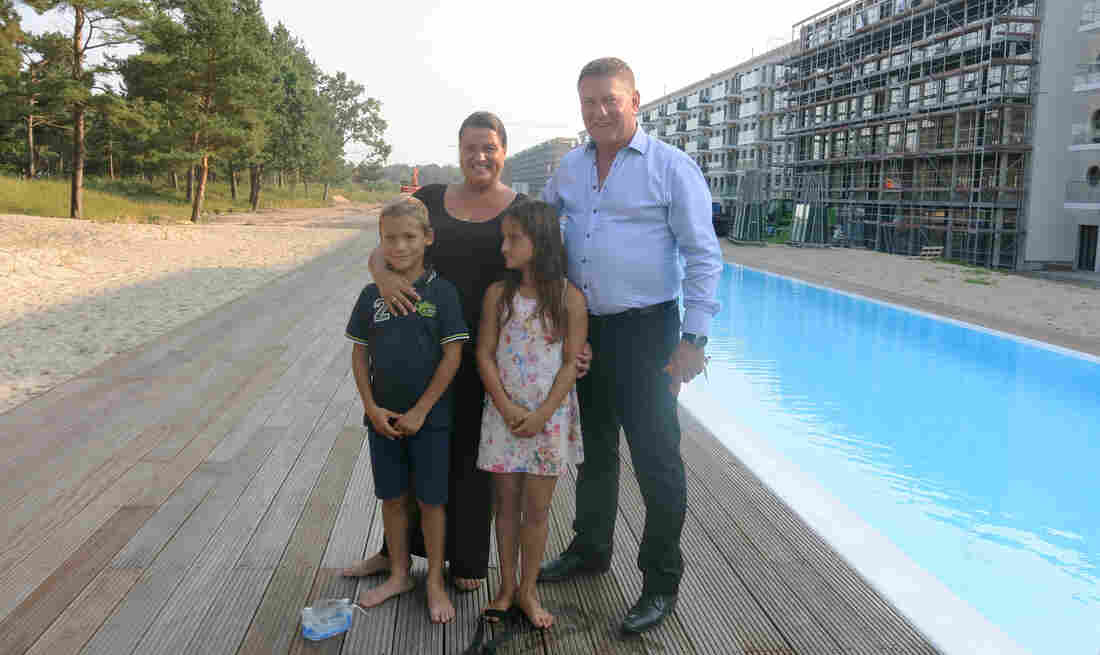
Peter and Yvett Sadewasser and their 8-year-old twins, Alexander and Josefina, were among the first families to move into one of the refurbished units. Soraya Sarhaddi Nelson/NPR hide caption

toggle caption Soraya Sarhaddi Nelson/NPR

Peter and Yvett Sadewasser and their 8-year-old twins, Alexander and Josefina, were among the first families to move into one of the refurbished units.

Soraya Sarhaddi Nelson/NPR

Nowadays, the sound of waves is drowned out by construction helping the former Nazi site "turn into a butterfly," as nearby billboards advertise. Busch has opened a hotel called Prora Solitaire in one of the buildings, which also includes 150 individually owned condominiums.

Busch says even in its unfinished state, the hotel boasted an 89 percent occupancy rate this past summer. The resort, he says, appeals to Germans curious about the Nazi past and those seeking to vacation closer to home, following recent terrorist attacks elsewhere in Europe.

The condos are also being snapped up, Busch says, with buyers getting huge tax breaks because of the complex's historic designation. They come from as far away as Dubai and pay as much as $700 per square foot, he says.

He calls the new project "the best answer for the old and ugly and horrible thinking and spirit of the Nazi time."

Yvett Sadewasser agrees. She and her husband and 8-year-old twins were among the first families to buy a condominium here. She says she became fascinated with the Prora site after she first visited as a little girl from the neighboring town of Binz. Her mother, a teacher, had rare access to what was then the East German military complex because some of the officers' children were in her class.

Today, the Sadewassers live in a modern, two-story home with exposed concrete and steel from the original Nazi structure. The dwelling appeals not only to the adults, but also to their children, Alexander and Josefina. Their mother says they love being close to the beach and having access to the building's fancy pool.
Enlarge this image

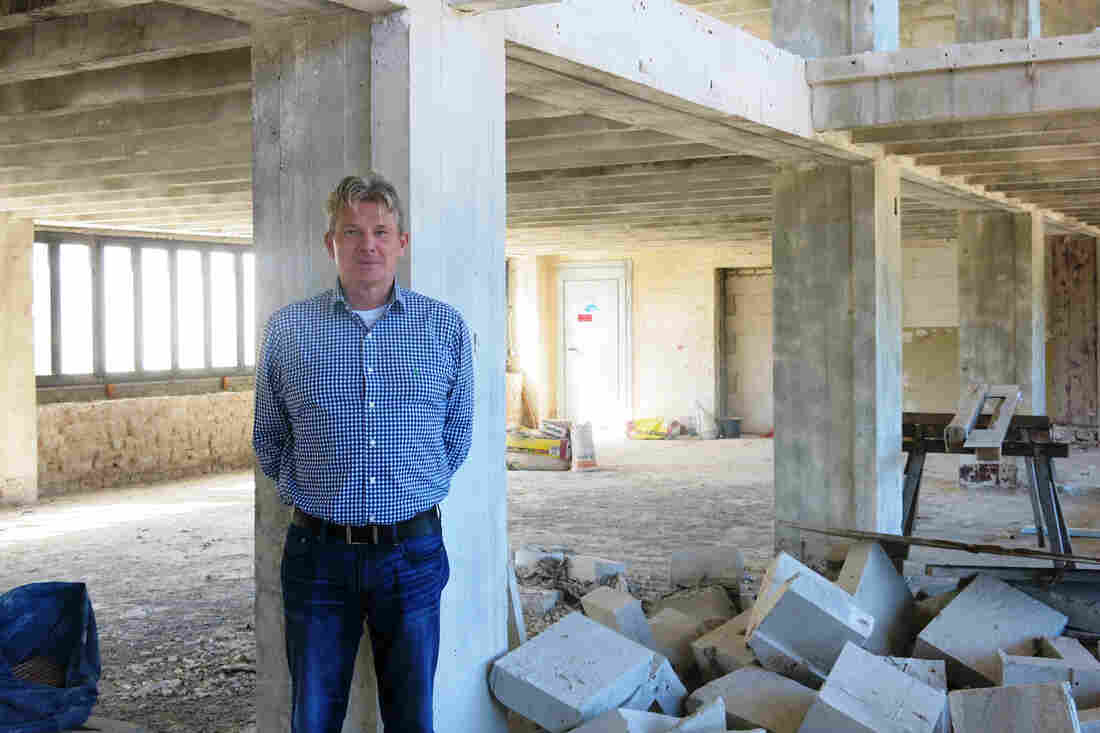
Developer Ernst Ulrich Busch says the former solarium is his favorite spot in the former "Strength through Joy" building he's refurbishing. He plans to convert the solarium into two-story apartments. Soraya Sarhaddi Nelson/NPR hide caption

toggle caption Soraya Sarhaddi Nelson/NPR

Developer Ernst Ulrich Busch says the former solarium is his favorite spot in the former "Strength through Joy" building he's refurbishing. He plans to convert the solarium into two-story apartments.

Soraya Sarhaddi Nelson/NPR

"I'm also interested in the history," Alexander tells me.

"Do you know who built this?" I ask.

He hesitates, then whispers: "Adolf Hitler." He quickly puts his hand over his mouth as if he's said a dirty word.

"He was a bad man," Alexander says.

"That's why we don't like to say his name," says Josefina.

Awareness of the site's grim history is something museum director Lucke and other critics of the project believe will dissipate with the conversion. Many historians and some former residents of the site during East German times feel it glosses over a dangerous part of German history that shouldn't be forgotten.

"There is no importance placed anymore on making it recognizable [as a Nazi landmark] even though it's designated a monument," Lucke says. These days, she says, "You can drink a latte macchiato there and slip next door into the sauna. I don't have anything against that, but you aren't really getting the context of this place."

Her museum, which had 60,000 visitors last year, is being evicted from one of the more central buildings in the complex, although the developers have pledged to provide a space for it in another structure at the far end.

Stefan Wolter, a historian and one-time East German Bausoldat or "construction soldier" stationed at the Prora site during the Communist era, fears the new complex will erode what little recognition there is today of East German abuses committed at the site. "What we went through was comparable to forced labor," he recalls. The construction soldiers were conscientious objectors pressed into labor by the Communist regime.

But Prora Mayor Karsten Schneider says he's cautiously optimistic that the development will turn out to be a good thing for local communities and that he's badgering investors to build not only vacation homes but also permanent housing, along with shops, businesses and other support services to accommodate the new project.

"We are on a good path and I hope it will continue," he said. "But ask me in five years, when they are done with the renovation."


Source: Along Germany's Coast, A Nazi Resort Becomes An Upscale Destination

Tuesday, October 4, 2016

Ryanair Steps Up Its Push Into Germany as Air Berlin Retreats

Ryanair Holdings Plc will add 10 new routes from Hamburg next summer as the low-cost giant seizes on a meltdown at Air Berlin Plc to offer 20 percent more flights in Germany in 2017.

Ryanair will open a base in Hamburg next month, stationing two jets there and adding seven routes from the north German city to take the total to 14. All of those destinations will be retained next year with three more, including Faro in Portugal and Thessaloniki in Greece, introduced, the company said Tuesday.

Europe's biggest discount airline is boosting operations in Germany after unprofitable Air Berlin last week announced the shuttering of its Hamburg base and five others in the country as it halves its fleet and cuts 1,200 jobs. Ryanair was already targeting expansion in the region's largest economy, where it plans to capture 20 percent of traffic, up from about 5 percent now.

"We know that the Ryanair offer will win through in the German market regardless of what happens to Air Berlin," Chief Marketing Officer Kenny Jacobs said at a briefing in Hamburg. Some other carriers look "artificially good" because of the low oil price and also "could be vulnerable," he added.

Ryanair's average ticket price slipped below 40 euros this summer compared with 46 euros in 2015 as overcapacity in Europe's short-haul market weighs on yields. Chief Executive Officer Michael O'Leary has said he's happy to engage in fare wars to defend and increase the Dublin-based carrier's market share.

'Bogus Merger'

Ryanair said that an arrangement under which Air Berlin plans to operate 40 surplus jets on behalf of Deutsche Lufthansa AG, the biggest German carrier, for five years is both negative for consumers and of dubious legality from an antitrust standpoint.

"There are questions on the legitimacy of any bogus merger," Ryanair Chief Operations Officer David O'Brien said in Hamburg. "We have yet to see the details, but it could well be that the European Union could become interested."

Ryanair, for which Germany is the fourth-largest market, is already stationing four additional aircraft at Berlin Schoenefeld Airport, for a total of nine, and will open a base at Nuremberg on Nov. 1 where it will locate one plane and serve six winter routes.

While the carrier currently ranks third in Germany, Air Berlin's retrenchment to focus on a fleet of just 75 planes will leave it vulnerable to being overtaken and Jacobs said the No. 2 spot is now the target.

Brexit Skeptic

Ryanair also has 50 extra aircraft due from next September "that conceivably could come to Germany," O'Brien said. Lufthansa is also set to build up the fleet of its Eurowings discount arm, with both the Air Berlin deal and a takeover of Brussels Airlines NV set to provide an injection of jets.

EasyJet Plc, Europe's second-biggest discount carrier, is also adding capacity to destinations including Berlin and Stuttgart, while Romanian carrier Blue Air said Tuesday that it too plans to ramp up its presence in Hamburg with flights to Liverpool, England, four times weekly starting next March.

Ryanair may also have spare capacity to direct at Germany as it curbs growth plans for the U.K. following the June 23 vote to leave the EU. While some carriers have said sterling's decline could draw in more tourists, helping to maintain passenger numbers, O'Brien said that may be a limited phenomenon.

Before it's here, it's on the Bloomberg Terminal. LEARN MORE
Source: Ryanair Steps Up Its Push Into Germany as Air Berlin Retreats

Monday, October 3, 2016

Hungary PM claims EU migrant quota referendum victory

Hungarian Prime Minister Viktor Orban, centre, delivers speech after referendum in Budapest. October 2, 2016Image copyright AP Image caption Prime Minister Viktor Orban called on EU leaders to note the result

Hungarian PM Viktor Orban has declared victory in a referendum on mandatory EU migrant quotas, despite a low turnout that appeared to render it invalid.

Nearly 98% of those who took part supported the government's call to reject the EU plan.

But only 43% of the electorate voted, short of the 50% required to be valid.

A government spokesman said the outcome was binding "politically and legally" but the opposition said the government did not have the support it needed.

Mr Orban urged EU decision makers to take note of the result and said he would change Hungary's constitution to make the decision binding.

The controversial EU plan to relocate 160,000 migrants across the bloc would mean Hungary receiving 1,294 asylum seekers.

Ferenc Gyurcsany, leader of the opposition Democratic Coalition, said the low turnout showed that most people did not support the government.

"According to this result with s uch low turnout, the people do not support the government. And this is good. The migration issue outreaches Hungarian borders."

Image copyright AP Image caption Opposition supporters rallied in Budapest on Sunday

But a government spokesman said the result could not be regarded as invalid.

"The government initiated the referendum, so both politically and legally the outcome is binding," he said.

"The 50% would have made a difference because parliament could have no alternative but to make a decision. But parliament is behind the government regarding the decision. This is a reinforced mandate for the government."

The referendum result is both a crushing defeat and an emphatic victory for Hungary's prime minister.

On the one hand, Viktor Orban led a prominent, expensive and relentless anti-EU and anti-migrant referendum campaign but failed to persuade most Hungarians to vote.

On the other hand, those who did vote sided with him almost unanimously, allowing him to trumpet that a higher percentage of Hungarians voted against EU migrant quotas than voted for EU membership 13 years ago.

Mr Orban says he is leading what he calls a counter-revolution against EU centralisation, a pushback against Brussels bossiness. He views himself as the man of the moment, speaking for the people of Europe.

He had hoped other countries would follow suit and hold their own referendum on migrant quotas. In fact other EU countries are simply ignoring the quotas.

What Hungary's prime minister is not calling for is "Huxit" - a Hungarian exit from the EU. Mr Orban is all too aware the his economy relies on EU subsidies.

During last year's migrant crisis, Hungary became a transit state on the Western Balkan route to Germany and other EU destinations.

In an effort to curb the influx, it sealed its border with Serbia and Croatia. The measure was popular at home but criticised by human rights groups.

Voters were asked: "Do you want the European Union to be able to mandate the obligatory resettlement of non-Hungarian citizens into Hungary even without the approval of the National Assembly?"

The EU proposal was meant to ease pressure on Greece and Italy, the main entry points for migrants and refugees into the bloc.

In December Hungary filed a court challenge against the EU plan, which would see relocations over two years.


Source: Hungary PM claims EU migrant quota referendum victory

Sunday, October 2, 2016

Hungary holds referendum on EU mandatory migrant plan

Hungarians in a polling station in the village of Roszke near the Serbian border, Hungary, 2 OctoberImage copyright Reuters Image caption Hungarians in a polling station in the village of Roszke near the Serbian border

People in Hungary are voting in a referendum on accepting mandatory EU quotas for relocating migrants.

Right-wing Prime Minister Viktor Orban opposes plans to relocate a total of 160,000 migrants across the bloc.

Under the scheme, announced after last year's migrant crisis, Hungary would receive 1,294 asylum seekers.

Opinion polls suggest strong support for a rejection among those who say they will vote. To be valid, turnout needs to be over 50% of voters.

During the migrant crisis, Hungary became a transit state on the Western Balkan route to Germany and other EU destinations.

In an effort to curb the influx, it sealed its border with Serbia and Croatia. The measure was popular at home but criticised by human rights groups.

Voters are being asked: "Do you want the European Union to be able to mandate the obligatory resettlement of non-Hungarian citizens into Hungary even without the approval of the National Assembly?"

Image copyright AP Image caption Mr Orban has previously described the quotas as "illegal and unreasonable"

In December Hungary filed a court challenge against the EU plan, which would see relocations over two years.

In a TV interview on Thursday, Mr Orban said: "If there are more 'no' votes than 'yes' votes, that means Hungarians do not accept the rule which the bureaucrats of the European Commission want to forcefully impose on us."

"The more migrants there are, the greater the risk of terror," he added, according to excerpts published by Reuters news agency.

The EU proposal was meant to ease pressure on Greece and Italy, the main entry points for migrants and refugees into the bloc.

Referendum explained, by Nick Thorpe, BBC News, Budapest Image copyright Reuters Why has the government called it?

Mr Orban closely links migration to terrorism, and what he regards as the dilution of European Christian culture. He wants to play a bigger role on the European stage, as a "champion of the concerns of ordinary Europeans", against the actions of "an unelected, liberal elite".

Mr Orban proposes that all migrants be put in a giant refugee camp in Libya, from which they can apply to come to Europe. His policy has proven popular in Hungary. His Fidesz party has regained voters it had lost, and the referendum is a useful organising tool ahead of the next parliamentary elections in 2018.

What is the mood?

Fidesz and the opposition nationalist party Jobbik favour a "No" vote, although Jobbik would privately like Mr Orban to fail. Some opposition parties propose a boycott, others propose spoiling one's ballot.

The tiny Liberal party urges people to vote "Yes".

To be valid, more than 50% of Hungary's 8.3 million electorat e needs to cast a valid vote.

What consequences could it have?

Legally none, politically many. As an EU member, Hungary is bound by EU rules. But the bloc's executive is wavering over compulsory quotas.

Mr Orban would like the satisfaction of Chancellor Angela Merkel falling from power in Germany, the EU abandoning compulsory quotas, and the Visegrad 4 countries (Hungary, Slovakia, Czech Republic and Poland) emerging as a strong power bloc for a Europe of nation-states, against the federal vision of French, German and other leaders.

If the referendum is not successful, however, after throwing so much money and effort into it, Mr Orban will look weak, even foolish.


Source: Hungary holds referendum on EU mandatory migrant plan

Saturday, October 1, 2016

7 European Destinations For a Traveler Who’s Seen It All

Real globetrotters who have been to numerous places all over the world share one problem: they're hard to impress. One location after another, it takes a while until they finally start to look alike. All pages of travel guides are already marked, yellowish and reread hundreds of times. Besides, tourists are everywhere, and they keep speaking of the same destinations. Someone just came back from Paris, another person goes to Rome, while this group of young backpackers is getting ready to hit the road and party in London. Even in Europe, the very developed continent, there are still places that have remained unknown like well-hidden treasures.

  • Faroe Islands
  • Incredibly beautiful, 18 of the Faroe Islands are scattered in the North Atlantic Ocean, between Norway and Iceland. What first draws a visitor's attention, are the magnificent mountains, countless sheep feeding on the green grass, brightly painted cottages and turf-roofed churches. The sceneries are breath-taking, dramatic fjords and enchanted villages stay in the memory forever. Even a traveler who's seen it simply must be charmed with a unique beauty of Faroe Islands, especially that even though this little country is such a gem, tourists rarely reach it. These pieces of land make a perfect place to escape the hustle and bustle, but without being entirely cut off the civilization. Technology is doing great, islands are well connected with road tunnels and can easily be reached from UK or Scandinavia.

    Faroe Islands

  • Muhu Island, Estonia
  • A perfect getaway, the Estonian island of Muhu is known as "a place where time rests." This may be understood in two ways. First of all, the people of Muhu take care of their traditions. They have kept everything that's valuable and nourished their culture for centuries. The landscapes have remained the same: enchanting and natural. Secondly, Muhu Island is so tranquil it makes you forget about clocks and calendars. It's the third biggest island in Estonia, situated over 2 kilometers from the larger Saaremaa. For luxury-seekers, there are a few excellent hotels and some of Estonia's finest restaurants.

    Muhu Island Estonia

  • Mostar, Bosnia-Herzegovina
  • Bosnia & Herzegovina, even though gorgeous, isn't as touristy as its famous neighbors. While most people head to Croatia and Montenegro to enjoy their coastal regions, Bosnia & Herzegovina remains quieter. Mostar still has its darker side reminding of the war and all tragic events that took place in the city over twenty years ago, yet there's lots of beauty in this town as well. Its cultural icon, The Old Bridge, stands proudly between medieval towers creating one of the most remarkable sceneries in Balkans. With the bridge and the rest of its enchanting old town, Mostar is a lovely city and can astonish even the kind of traveler who's seen it all.

    Mostar Bosnia-Herzegovina

  • Åland Islands
  • This small archipelago is a very special mixture: it officially belongs to Finland, but its residents run their affairs without asking the "motherland" for permission. They have an independent parliament, their flag, and stamps. The fact Ålanders speak Swedish and have a special tax status in the European Union only adds to the geopolitical uniqueness of the islands. There are some fantastic beaches attracting holiday-makers from nearby countries, but in general Åland Islands are rather sleepy, quiet and delightfully tranquil.

    aland Islands

  • Sighisoara, Romania
  • A small town situated in the legendary region of Transylvania, Sighisoara is truly magical. A mixture of fairy-tale and nightmarish horror story, its colorful houses and pretty narrow streets make it look sweet, but the Vlad Dracul House reminds It's a place where Vlad Ţepeş (also known as The Impaler or Dracula), one of the world's most famous malicious characters, was born. Because of its unique historical value, the town has been recognized by UNESCO and included on the list of World Heritage Sites. Each year in July, amongst the city's fortified walls, Medieval Festival of the Arts takes place.

    Sighisoara Romania

  • Łódź, Poland
  • Łódź isn't pretty. It's not the kind of town that steals your heart away as soon as you enter its gates. It's harsh and edgy, but there's something intriguing in its complicated character. Once you build a relationship with this city, it's going to last. Łódź will keep surprising you: with the amazingly vivid cultural life, the fascinating festivals, the film scene and vibrant night-life. Łódź is the center of Polish film industry, and it'll not let you forget about it, as you'll probably keep meeting students from the local film academy and hang out in cinemas. Don't get mislead by this city's industrial look and do your best to explore it.

    Łódź

  • Ikaria, Greece
  • Because of its stunning location and rich history, much of Greece is very touristy. As a traveler who's seen it all, you're probably slightly fed up with the loud crowds of tourists, and the last thing you dream of is ending up among them.

    Ikaria Greece

    But wait for a second and don't cross Greece off your list. There are still places across this fascinating country where tourism, even if it exists, is rather unimposing. Ikaria is a perfect example. Visit this picturesque island where the pristine gems of nature still aren't outnumbered by tourists. Chat with the locals, enjoy the gorgeous beaches, hike, walk, drive around and eat as much as you can, because the Greek cuisine is heavenly.


    Source: 7 European Destinations For a Traveler Who's Seen It All